Tuesday 5th I went to LSC this morning to sort out my mooring strops which were still out in the lagoon after the lift out. These are currently drying out in the cockpit and will come home for checking and maintenance later his month.
The rest of the hull has been scraped and about half of the removed debris cleared up from under the boat. So far 2 full buckets of barnacles and seaweed have gone into a heap by the concrete wall along with similar stuff from other boats.
After a bit of sorting in the cabin I powered up the bilge drier pumps which removed water from the engine compartment but nowhere else. Neither of the pumps in the main locker seem to be self priming at the moment so I will be ordering another 2 tonight and then I can either replace the current ones or scavenge valve parts (from memory there are several springs and valve plungers missing).
I deflated the tender and it is now stored in the shed for the winter. The patches on the aft bouyancy chambers need attention to stop the leaks so that will be a springtime task.
My winter jobs list includes fixing these pumps, finishing the pickup installation under the cabin floor and writing appropriate over run times for each pump into the software. The new pumps will be arriving either the 7th or 8th so I can prioritise this task and dry out the bilges. That should reduce the amount of condensation in the boat over the winter.
Monday 11th
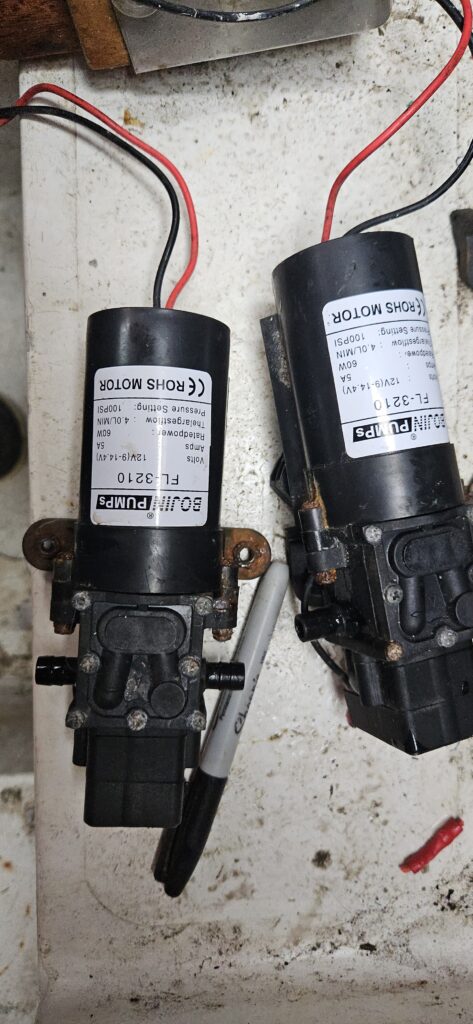 I started the day by going to the boat to fit the two replacement bilge drier pumps and start some of the other jobs. The two pumps have been fitted but I will need to repeat the bolting process as the original washers seem to have corroded. I also re-soldered some leads that were coming off the control board connectors. The end product of that work was that the three mid-section compartments are now fairly empty of water (including under the cabin floor) so there should be a bit less condensation happening inside this winter.
I still need to work out how long the over-run needs to be for each pump and install the junk filter under the cabin floor as well as finding the location of the short between the signals for pumps 3 & 4. Sometime I should be able to combine the two removed pumps to make one spare with all the required valve parts and springs.
The second job was to remove the port side cabin headlining and re-glue the bits where the spray adhesive proved inadequate. While doing that I realised that at least some of the water leakage seems to be coming into the cabin via the U bolt that attaches the lower shrouds to the roof. The nuts have been removed so I can take out the fitting and re-mount it with plenty of sealant before re-attaching the headlining board.
 The third major job was to investigate why the wind speed sensor does not work. The bearing seems to have seized up so that it can only spin when forced round by hand. That seems to involve the bearing turning in its housing. I have emailed the supplier asking if they offer spare parts (either the whole bottom housing or just the bearings) – They now charge £249.60 for the device so buying a new one is not a feasible option. There is also an “improved” version but that is over £300. While dismantling the sensor I also found that the power lead has fallen off the PC board so there will need to be a quick soldering session if I do get replacement parts.
I headed home for lunch at around 12.
Tuesday 12th I seem to have freed up the anemometer bearing enough to make it able to rotate. This needed me to remove the cups and drive the spindle with an electric drill. It still squeaks so may under estimate the speed but that seems to be the best I can achieve as there is no response so far from the original supplier and a replacement will now cost around £250. Needless to say I am not wasting that much on it as having a wind speed indication on the navigation computer is somewhat of a luxury. There is also an “improved” version available which costs over £300. Hopefully the improvement includes making sure it works for more than a season.
Monday 18th It has been drizzling overnight so the extension roof is too wet to work on it this morning. A brief look didn’t indicate any obvious leaks first thing so I went to the boat.
 First job was to take off the lower shroud mounting U bolts and replace them with CT1 sealant under the plates and around the holes through the cabin roof. That wasn’t a particularly long job but it did require a trip to buy a sealant gun as all mine seem to have managed to migrate to Doncaster. There is nothing much to show for the replacement sealant but hopefully this will have resolved the leaks above the headlining. There was a little suggestion of leakage from one of the hatch cover attachment bolts but the rest of the moisture evident this morning looked like condensation. This should be helped by my plan to fit some sort of insulation between the fibreglass and the headlining.
 Second job was to re-do the connections for all of the pumps in the main cabin locker. I then re-soldered the broken wires on two of the Arduino cables and used some Araldite to reinforce the attachment onto the plugs & sockets.
 The power on test sequence initially seemed to work but then the Arduino started to act rather strangely – I am not sure if that is because the real time clock has lost it’s time setting, the Arduino is not getting enough power or there is some other sort of hardware failure. – The behavior did not resemble the proper program and there was no power light on the relay board despite the relays having initially run properly. The laptop battery was too low to be able to get the programming software running and check what is happening. I will have to try that again with a properly working computer.
I went home at around 12:30 for lunch.
Tuesday 19th I got to the boat about 1:30 and checked out the Arduino system with the laptop and voltmeter. – it seems to be working but there is no 5 volt power feed for the relays. It looks like either a temporary short or else I plugged in the cable for the relays incorrectly yesterday. – The first 2 pins are ground ansd the next is the power feed so if I connected it one place off then I could have shorted 0 and 5 volt lines. The ground wire has also fallen off the plug today while I was testing it so that could also be the underlying reason for the failure to run pumps.
After the testing I was trying to attach cable tie bases onto the ceiling to tidy up the cables between the headlining and the ceiling but neither double sided tape nor impact adhesive wanted to stick to the fibreglass reliably. Maybe the cold is affecting the solvent so I have also cable tied the VHF aerial and lighting wires to the fiberglassed in conduits in the hope that a long slow solvent evaporation will give a better adhesion.
I also added a couple of screws to reinforce the “filler” fillets that fix the oak battens onto the ceiling for the headlining. I am intending to make 8 aluminium or stainless steel brackets to help mount the headlining boards at the edges as they are currently only held in place by the screwed in battens in the middle of the ceiling.
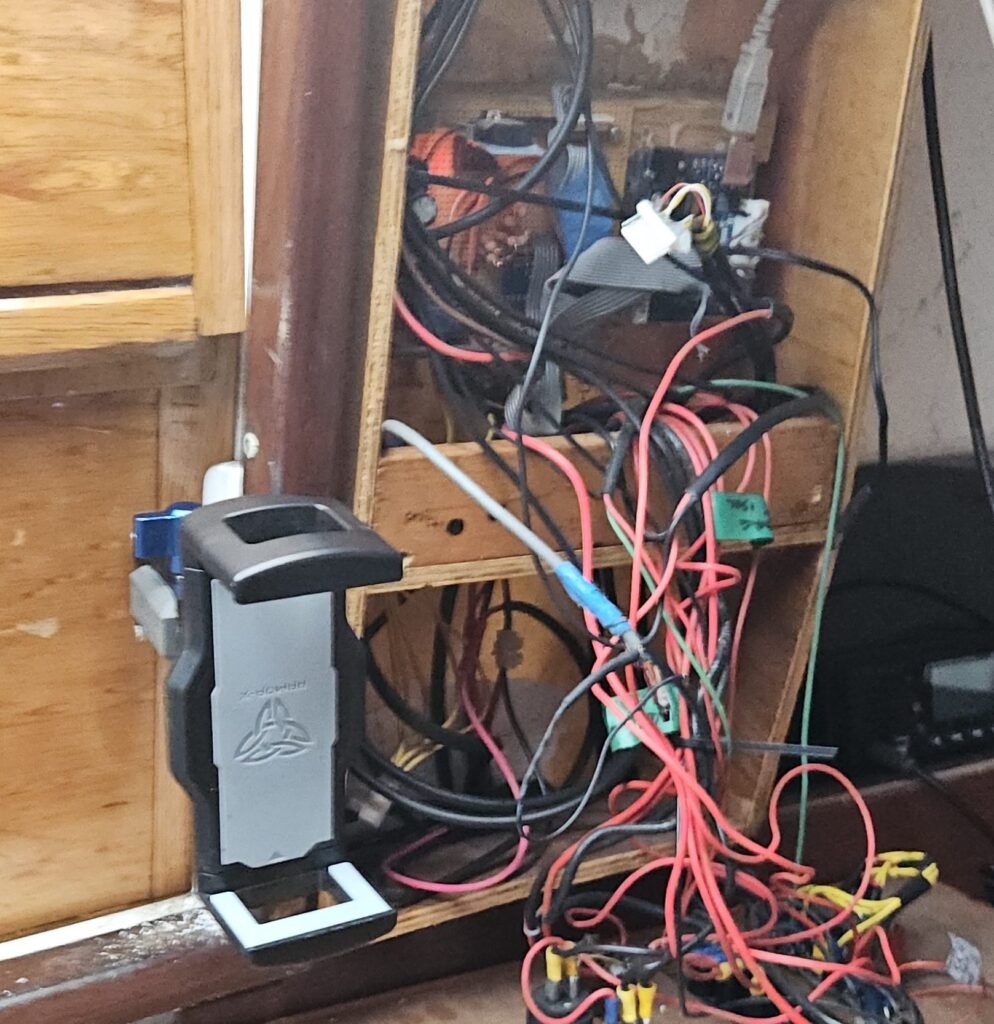 The last job for today was to drill and screw the tablet mounting bracket fitting. I decided to put it towards the bottom of the port edge of the companionway. It should be out of the worst of the spray there without being in the way too much and can also be swung round inside the washboards if required. There are only four small holes in the fibreglass if I decide to move it somewhere else later and this position will also be convenient for charging it using the USB power outlets on the switch panel.
 I headed for home at 3:30 and then washed out and checked the two “spares” pumps. Once they are dry they will be stored in bags with other boat bits in the shed – One should work as all the parts are present and the other has one valve and a spring missing. I think I have the spring somewhere so that may eventually migrate back to being with the pump.
20th There was plenty of snow in in other parts of the country yesterday and overnight but none in Poole. We did have heavy frost on cars and roof tops though and tomorrow is forecast to be as cold if not worse. As a consequence the planned mooring maintenance session tomorrow has been stood down for safety reasons. That work day may therefore happen on Friday instead or possibly over the weekend as weather permits.
Originally posted 5th November. Updated 18th, 19th & 20th.
For more details of the bilge drier pumps, these were originally installed from 2nd Jan 2020 onwards. See https://www.rathenice.com/2020/10/28/bilge-pumps-big-and-small-getting-a-dry-interior-at-last/