Saturday 1st March After a quick sandwich lunch I headed over to the sailing club at 1pm to work on the boat. My first job was to re-fit the sliding chart table onto its runners.
After trying the bilge drainer software coupled to the laptop I discovered a broken wire that handles the communication with the real time clock board – That would definitely explain the failure to trigger any pumps. I had left my electrical tools in the car so that minor issue will get fixed next time I go.
I spent the rest of my time at the boat fitting the two bow mooring line fairleads. One of the four bolts was a real pain because it ended up coming through the deck straight into the fiberglass that holds the chain locker bulkhead in place. I had to remove plywood and fiberglass to get the nut onto it and tighten it up. I dropped at least 5 nuts into the chain locker trying to get the threads started so that one bolt took well over an hour to fit.
Sunday 2nd After lunch I got a little time at the boat doing a couple of smaller jobs and working on the port stern mooring cleat.
- Added the forward edge and port side rubber seals on the fore hatch.
- Soldered on the broken wire to get the bilge drain pump system working again.
- I found a couple of rigging cotter pins on the mast were retained only by locking wire so replaced this with proper locking rings.
 The mooring cleat problem got a little more difficult because I discovered that one original bolt has sheared off leaving it’s mounting hardware inside and the other cannot be undone because the captive nut has detached. I also discovered that there is a roughly 1.25 inch deep rectangular section ‘tube’ along the top of the cockpit edge. That seems to be full of black sludge so may once have been empty or else it was wood but is now entirely rotted away. Either way this may be the route by which water has been getting into the fuel locker every time it rains.
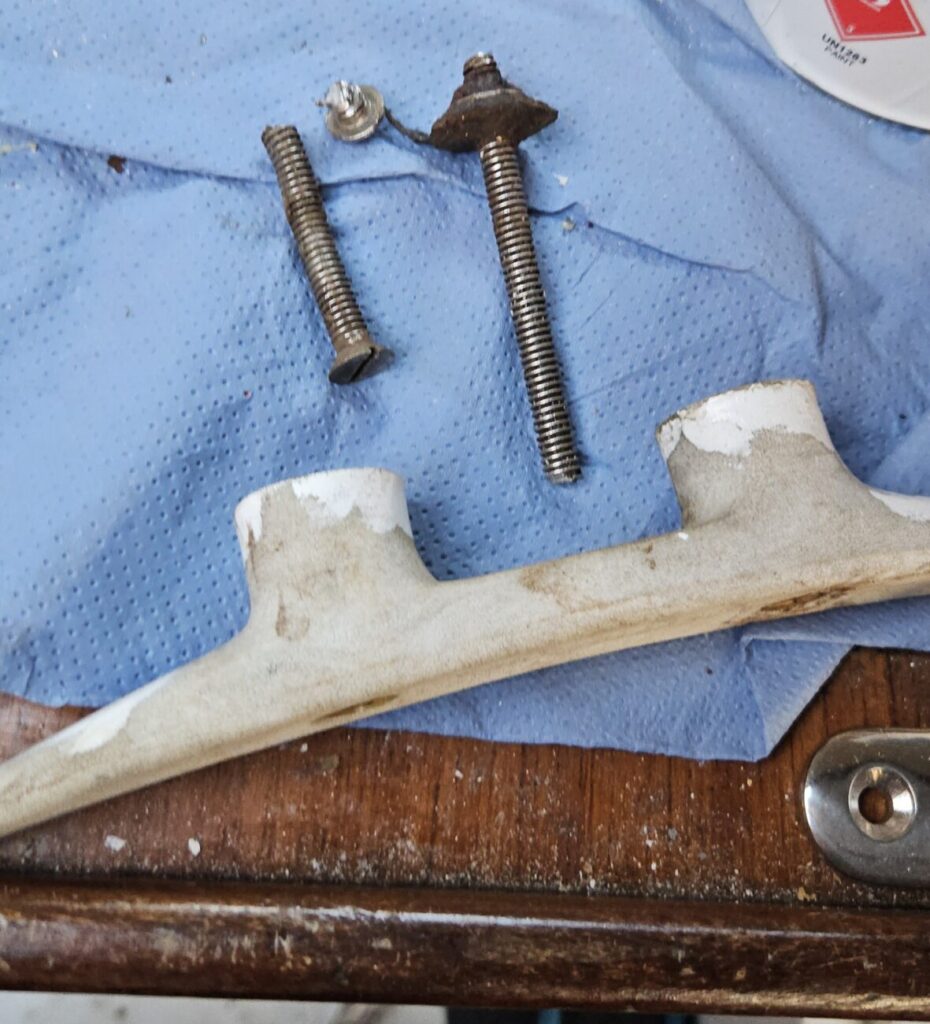 First the cleat needed to be removed which involved cutting the non-snapped bolt. I then filled at least some of the void with expanding foam which ejected some of the rubbish from inside and hopefully has sealed in a lot more. I have left this foam to harden overnight and intend to install some sort of reinforcing tubes at the same time that I repair the damaged surface molding. That will avoid crushing the rectangular compartment when I tighten down the cleat mounting bolts.
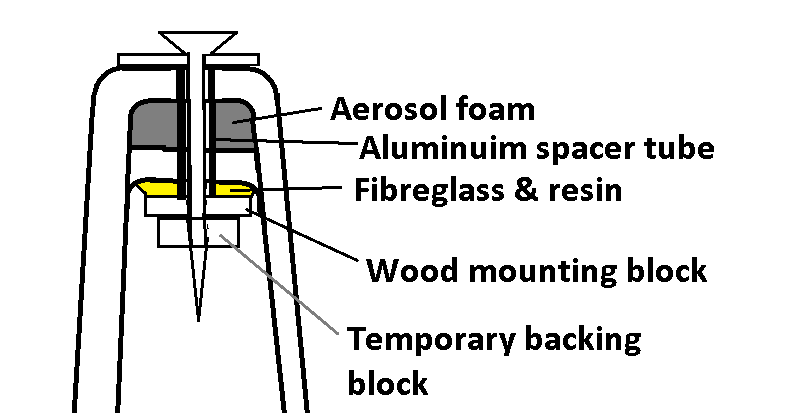
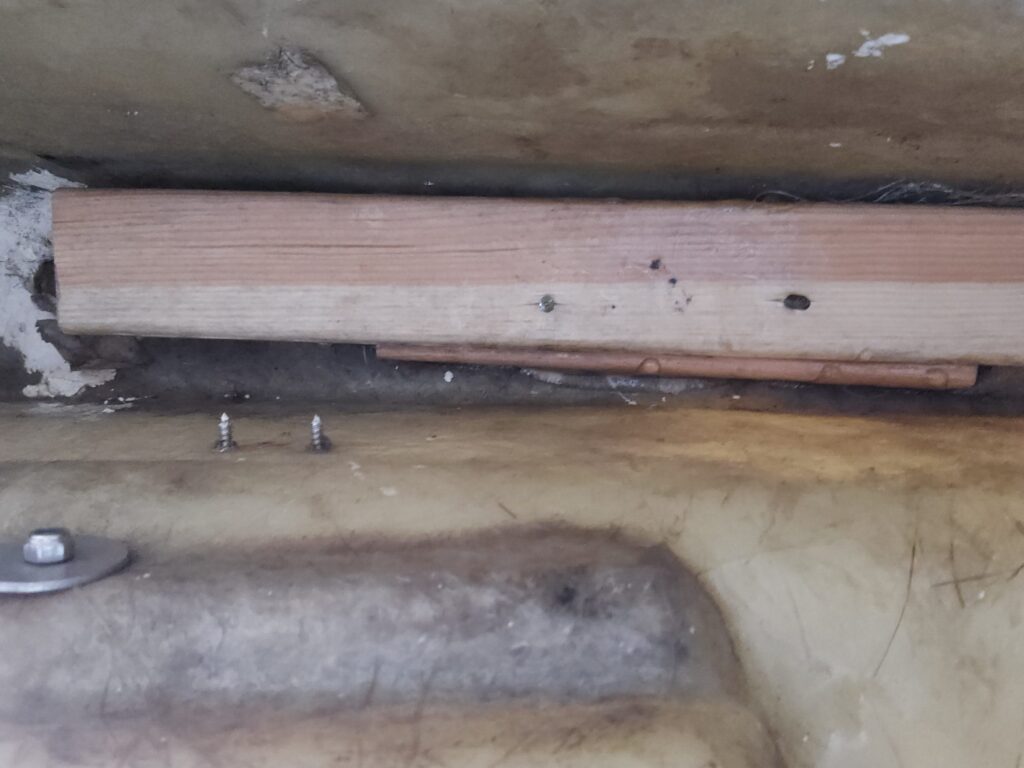
Monday 3rd After a morning of medical checkups for my wife and the dog, I made myself lunch and took it to the sailing club. This afternoon’s achievement was to tidy up the broken parts of the mooring cleat by re-drilling each hole as well as making the aluminium spacers & a wooden backing block. Once that was done the resin was mixed and saturated into three layers of woven glass tape which should form an adequate packing to attach the backing block to the cockpit coaming. The whole stack was fitted into the space and held in place with two screws and a pair of penny washers. The underside of the molding is not smooth and the space is inaccessible for properly roughening the interior surface, therefore I am hoping that this will hold everything in place while the resin cures overnight and the right pieces will come out easily tomorrow. I will need to add another piece of resin soaked glass matting on the underside to ensure the wood remains rot free in the future.
 |
 |
 |
The required 10 cm long stainless steel mounting bolts are on order and should be with me by the end of the week so there is a little time to cut out the damaged fiberglass, laminate the replacement, tidy everything up and paint it all before replacing the cleat.
Tuesday 4th I went to LSC at about 9:15 and took apart the stack of wood underneath the backing block. This all came off easily and the block stayed in the right place despite the resin feeling a little sticky still.
 I then used the battery angle grinder with a flap wheel to cut away the damaged fiberglass at the top around both fixing holes. It was already fairly warm by 10:30 when I had finished, so I cut four layers of woven glass tape and made appropriately spaced holes in those. I then mixed the hardener in some resin and laid up those layers. There was still some resin left so I added another three layers of tape to ensure a level finish in the centre and use up most of the ready mixed resin. The extra bit in the container was gelling nicely by about 20 minutes after I had finished so I left this to fully set.
 The next job that I started was sanding off the damaged varnish on the outside face of the two cockpit lockers. I did the starboard one first to minimise the amount of dust and varnish flakes that could get onto the soft fibreglass. Not really finished yet but I had used all of the batteries and it didn’t seem worth rigging up the power lead just to charge them.
I also did a bit of tidying up inside the cabin so I can now easily access the end of the pilot berth where I intend to install some insulation around the ‘ice box’ section of the starboard cockpit locker. This is directly below the section of the chart desk that regularly flooded so it is not surprising that there was some evidence of water getting into the stuff that was stored in this area- None of that seems to have got into the locker space underneath though. Hopefully insulating this area will reduce the potential for condensation in the future.
I headed home at 3:00, exactly the same time that Karl had finished cleaning and polishing the above waterline section of his boat’s hull.
Friday 7th Helen was doing toddlers this morning, having dropped her off I went shopping for filler to make the core for the rudder repair and also to get some wood to make a stair gate adapter ready for toddlers next week. This kept me busy all morning and for part of the afternoon as well.
Saturday This morning I got a new can of antifouling paint and then went to B&Q for the second day running to get another piece of plywood and strip wood to make a replacement for the boat sink cover – The original one had a bit of Formica covering it to act as a small worktop so I may organise something similar later on but at present it will just be plywood with two bits of strip-wood to reinforce it and stop it sliding around.
Around 1:30 I went to the boat.
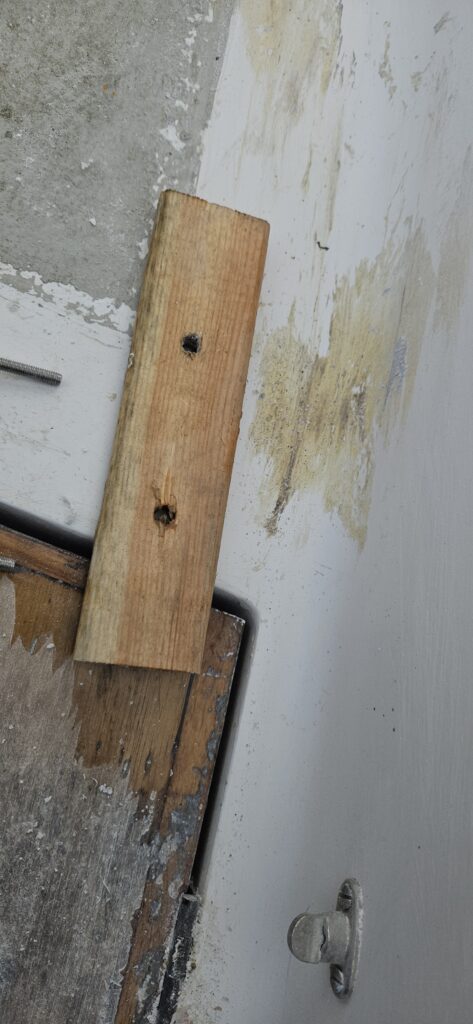
 The first job was trimming down the fibreglass repair on the cockpit coming. The surform and some emery cloth made a good job of that but there will need to be a little filler added to get a completely flat surface. While drilling the bolt holes the backing block came off inside. The resin still felt a little sticky so that is probably why the wood was not firmly attached. The fibreglass kit is all at home at present so I was not able to resolve this issue today
The second job was fitting the port side stern fairlead. Having got this done there will now be two sets of wooden reinforcing blocks in that side coming that need fiberglassing into place at the same time.
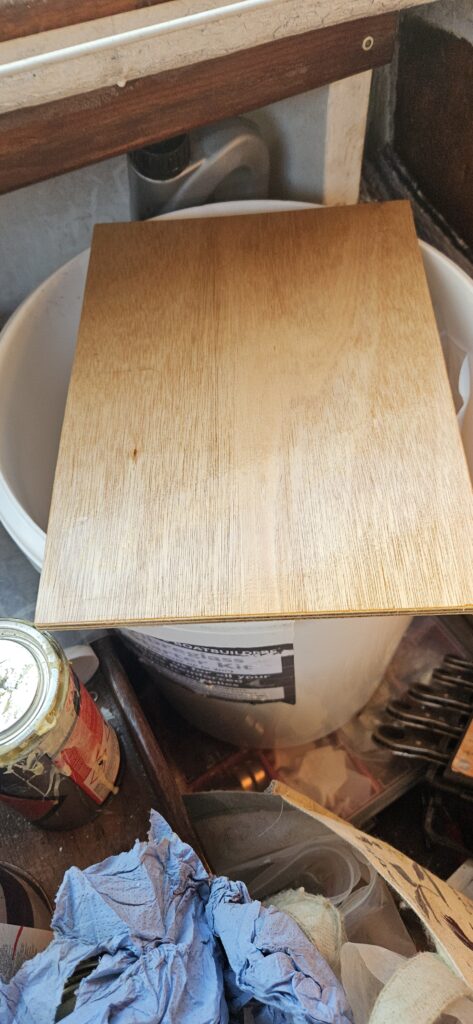
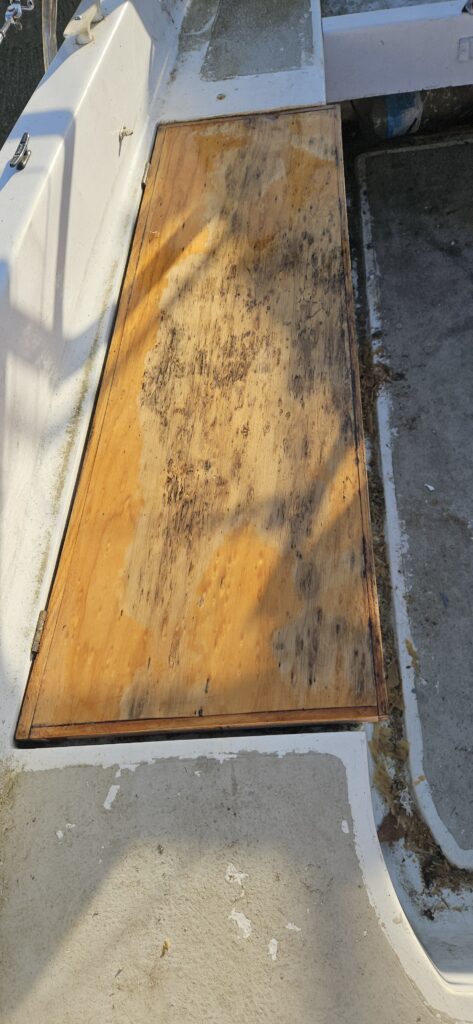 The other job that I made a start on this afternoon was the varnishing of the cockpit locker lids – I put one coat of varnish on the starboard one and also on the piece of plywood which will eventually have the separate electronics modules mounted on it. It is a little bit of a gamble doing outside varnishing with no protection from the weather but I hope the forecast is correct and there will be no rain.
Sunday I was at the boat around 2pm. The first job was to mix up a little of the filler and spread it reasonably thickly on the cockpit coming. I had forgotten to bring the resin so there was no potential to re-attach the backing block for the cleat or to fibreglass in either of the fairlead backing blocks.
Next I emptied the stored items out of the pilot berth so I could get to the area where I had been intending to add the insulation around the Ice box locker. This is going to create a lot of mess in the immediate future as the insulation slabs are all much too thick to fit into the available spaces. This might get done in the following few days but it didn’t seem all that important right now. It did at least trigger a bit of a clean up in that area and identified that there is some condensation in the small locker and water leaking from the under floor area into the water tank locker – Some sanding and varnishing needed there and probably a bit of foam needed to keep the water ingress down.
 While checking the engine compartment I discovered that the inboard prop shaft seal is leaking grease out into the engine compartment. This seems to be associated with some rust on the face of the seal so I suspect the spring has corroded through. I am hoping that I can uncouple the flexible joint and replace the inner seal without having to take out the stuffing box. Even if that is possible it will be much easier to do the job before the re-launch so that is now right at the top of my to do list and I will have to remember to fit the seal with the spring on the inside so that it will be protected from water by the grease packing. Looking back through this blog series the original seals were fitted in 2018 and they havent really had much use in terms of rotations of the shaft so I will want to check the cause of the failure carefully.
By 3:45 the filler had all set hard so I sanded it all down ready for painting and then drilled out the two bolt holes for the cleat. Obviously there was a lot of dust around so I brushed that up and will allow anything that was missed to blow away and settle before trying to paint the area.
My final job was to varnish the second side of the electronics mounting board. On the way home before 4:30 so I have time for a long walk with willow while Helen does her flute lessons.
 Monday I spent the morning doing the fibreglass repairs on the rudder and then painted the immersed area with antifouling undercoat.
Willow got a long walk after lunch while the undercoat dried. by early evening the paint had dried enough to add the first antifouling coat so that can dry overnight.
Tuesday I left for LSC at quarter to 8 and did a bit of work on my boat while waiting for the rest of the team of barge buoyancy experts.
 As well as cutting the edges of the basin cover to fit round the gimbal mount and water pump, I managed to get several bits of cabin furnishings and the port cockpit locker cover varnished. These were all left drying while we waited for the tide to drop enough to be able to work on the crane barge. As the bottom leaks it took until around 12:30 before the tide fell enough to allow the containers to be put back in. This was a bit of a challenge as there is an internal bulkhead and various bits of internal framework which need 2 or 3 containers packing vertically around them so that the lowest one is almost on the bottom of the barge. I left at 1pm by which time there were only a few left to get in.
 In the afternoon I added a second coat to the antifouling paint on the rudder. This and the mooring strops are now ready to go back to the boat.
Wednesday The plan for today was to go to Birmingham to check on Helen’s parents
 Thursday I made an early start today because key people seem to be unavailable at high tides for the next couple of days to try to get the mast crane into the right place to do the Saturday morning lifts. There is a high tide of 2.1M at 7:48 according to the tide tables on my phone so I am intending to make the best use I can of that one – Taking the ratchet straps with me in case I need more force to get it moving than I can deliver by pulling on ropes.
In reality the tide had already done all the work so another member and I turned the barge round and moved it along to being just inshore of the first boat to be worked on. That was all finished before 8:30.
My main project on the boat today was to disconnect the prop shaft, do whatever is needed to replace the seal and then sort out the engine bearer where the gear selector is standing on it and preventing the mountings from dampening the vibrations.
 The shaft pulled out fairly easily and, although it is fairly far aft of the engine, I could lever the seal out using a screwdriver. The cause of the failed seal looks as if it was electrolytic corrosion because there is a large hole in the metal structure in contact with the bronze body of the stuffing box. That shouldn’t be a problem with the new seal as the whole surface is rubber even though there is an internal soil spring and a stainless steel part that makes the whole thing rigid.
I managed to thread the new seal onto the shaft fairly easily and get it at least partially into the housing but the replacement does not seem to be as firmly gripping the housing as the original one did. I may have to make a device to retain the seal but first I will make a driver block to see if I can get the seal further into the stuffing box.
 As the prop shaft is disconnected I took out the starboard rear engine mount and took it home to cut out the area where the gear selector rests on it. This piece of cutting took around 3 minutes using the battery powered angle grinder.
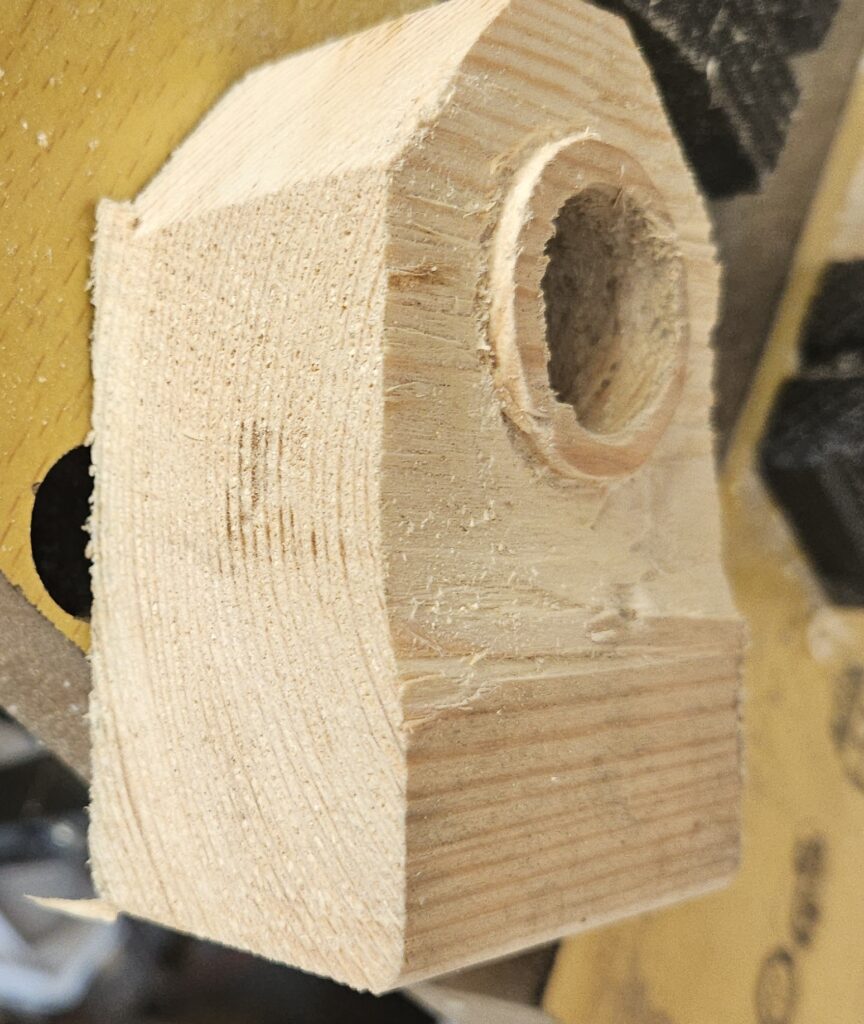 Likewise making the driving block was quickly achieved using a 1” whole saw for the shaft clearance and the next size up to cut the outside edge of the face that will be in contact with the seal.
Saturday 15th Hopefully I can finish off the engine jobs and do some hull cleaning sometime today although we will need to do a food shop first. I made it to the boat around 2pm.
 The first job was to replace the modified engine mount and the electrical grounding plate that had also been removed. There is now a decent clearance between the gear selector and the fiberglassed mounting frame. Hopefully that will help silence the engine a little however it may also mean the engine and shaft are out of alignment as it looks to me that the engine is now a few millimetres lower at the mounting point. I will check that once the boat is on the mooring as it is possible that the hull shape is slightly different on land compared to in the water.
 Second job was to use the block to tap the oil seal into position properly, re-couple the universal joint and connect the lubrication pipe back onto the stuffing box. I haven’t yet checked the alignment as I wasn’t sure where my feeler gauge was. The insulating tape on the shaft is an indication of the orientation of the cotter pin that locks the coupling to the prop shaft. This pin is slightly smaller than the holes that it goes through so the longitudinal piece of tape needs to be uppermost before undoing the coupling bolts otherwise the pin can slide out into the bilge.
While doing the lubrication tube I realised that the manual bilge pump tube was not going to the lowest part of the engine compartment. I moved that into place but it will need a few cable ties to attach it onto the electric pump tube and keep it effective.
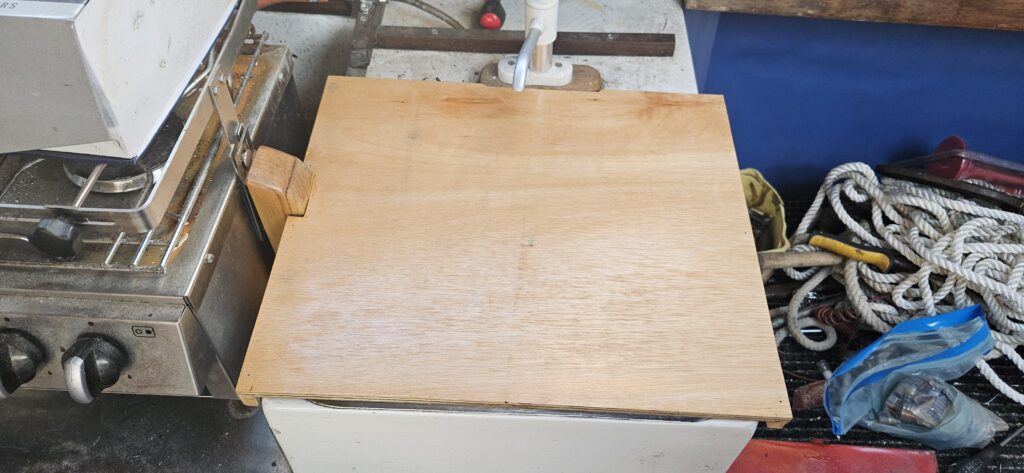 The third job was to give the cockpit coaming another coat of white paint where the mooring cleat has been repaired. I also then gave the two locker lids, sink cover and electrical board another coat of varnish.
As I was leaving I put this year’s harbour dues sticker on top of the previous two so I am identifiably legal this time before the boat goes back in the water (27th March).
Sunday 16th After church we went to LSC for our drinks and then had lunch there becausw we needed to get our tickets for next week’s “Cruiser supper” event. I took Helen home at 1:00 and changed into working clothes before returning.
My first job was to bolt on the port stern mooring cleat – Unfortunately I forgot to replace the backing block so that omission will need correcting sometime next week.
While tidying up the pilot berth last week I found the cross piece that goes on the headlining just forward of the hatch. This needed a 4 mm bolt to hold it in position so I cut one to the right length and installed it.
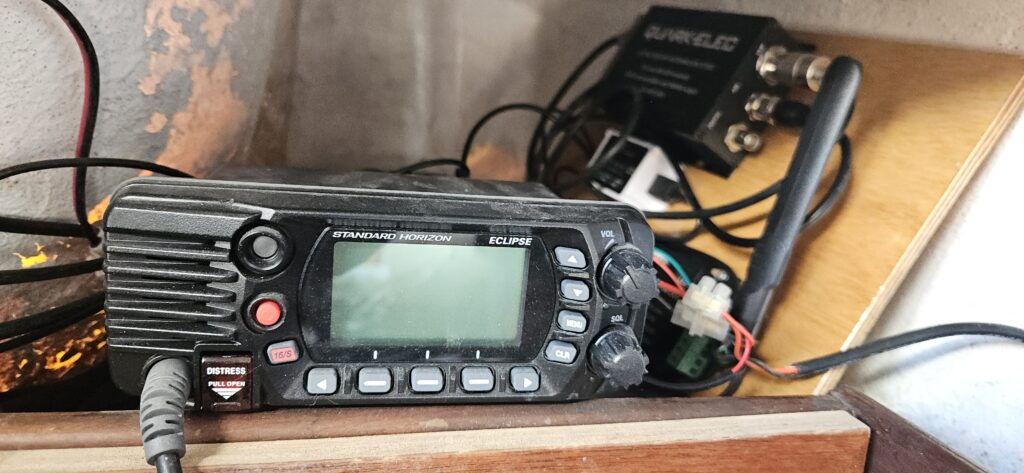
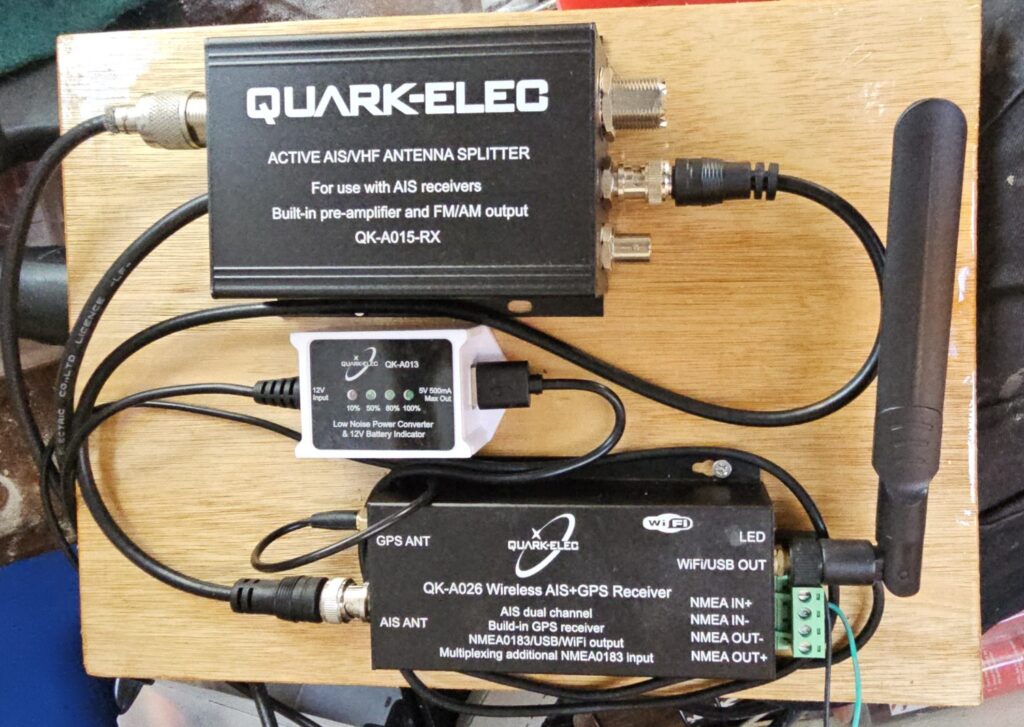 The third job for today was to install the wifi transmitter and the AIS receiver on their piece of plywood and temporarily place it alongside the VHF radio. I don’t seem to have the piece of Velcro with me which I had intended to use to keep it in position but that also can be done in the future.
Today’s biggest task was to scrub the underwater part of the hull ready for painting and antifouling. This took 3 buckets of water and kept me busy for almost 90 minutes. There are still a few tube worm burrows needing scraping off but most of the hull is ready for the next step. The bottom of the keels and a strip about an inch wide at the bottom didn’t get any attention while the boat was on the trailer so I need to do a tie coat in those areas and also in some other places where the cream coloured fibreglass is showing through. After that I will add two coats of antifouling.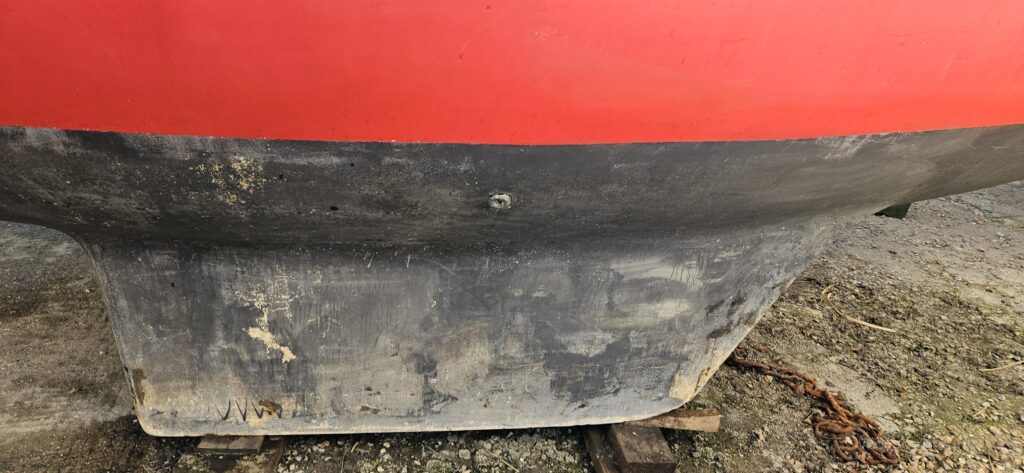

During the refurbishment my waterline was done to match the original but I am tempted to move the it up by about 2cm this time as there was quite a bit of algae growing on the red paint.
 Monday 17th Ten days to splash. After dealing with a medical appointment for Helen I went to the sailing club and spent the morning sanding the areas of the hull which need the tie coat of underwater primer. I then painted all of those and headed home at around 12:00 to let it all dry.
There are a few areas where either fibreglass or filler are needed because it looks as if the keels have been in contact with stones or concrete objects and chipped away the original. These were all hidden or inaccessible while the boat was on the trailer so this is my first opportunity to deal with the problems. It is due to get warm later in the week so I may decide to do some more work with the angle grinder and then replace the worst areas of damaged fibreglass or it may be simpler to add filler and see if that lasts until lift out in October. This type of problem would be easier to resolve if I put the boat on a higher set of blocks next time as I cannot properly access the bottom of the keels.
Tuesday  Today I was at the sailing club at around 8:00. The main job for me was to paint on the first coat of antifouling but before that I put a bit of filler into some of the damaged areas of fibreglass in the bottom of the keels.
By the time I had finished the painting job Karl had arrived to do his second coat of anti-fouling. While he was waiting for Dawn we took out his inverter as it is not currently working. It did do one slightly dodgy attempt at running his 240V portable Hoover but wouldn’t make any further attempts. That gives me a slight clue as to the problem but I will check further with my test meter at home. 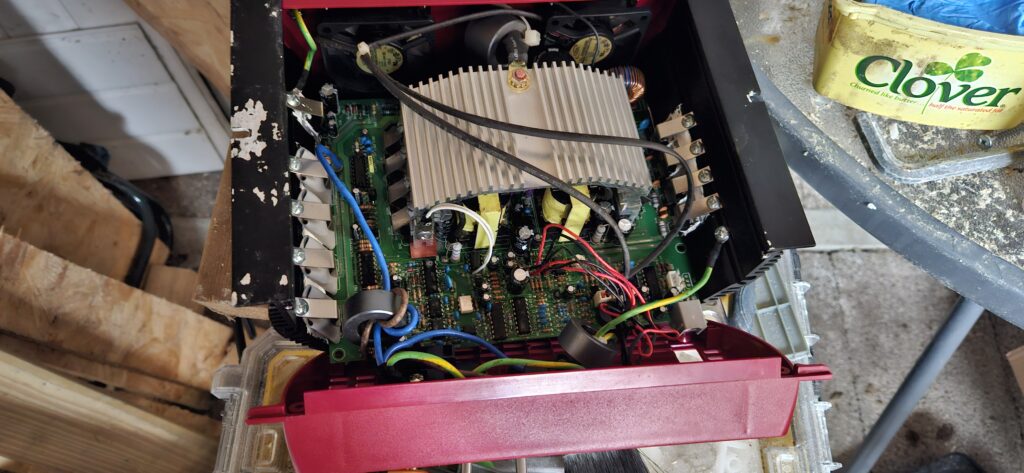
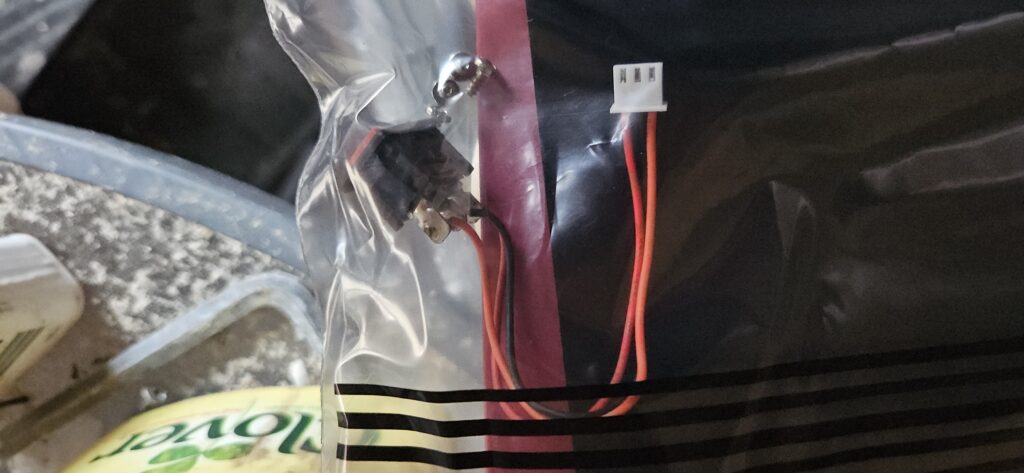 It is a 2 position middle off switch which selects either on or remote control and subsequent testing showed the switch as being open circuit in both of the ‘on’ positions. I have ordered a replacement (3 actually) which should arrive on Thursday.
Wednesday At around 8:30 I headed for the sailing club to do the second coat of anti-fouling paint. I then did a bit of tidying up in the cabin and brought various bits of stuff back to the shed in a vague attempt at getting the inside of the boat ready for the launch.
Friday I spent most of the afternoon at the boat starting to sort through tools and the spare part collection trying to ensure that I have everything that I need and not too much extra clutter.
Saturday This morning I cleaned the outside of the cabin and decks to finally remove all of the algal growth that has been there since we left the storage area in Retford. Achieving this wore through two green scrubbing pads and created four buckets of very mucky water so the boat now looks reasonably presentable. Meanwhile Helen took Willow for a walk to the coffee shop up the road from the sailing club and then back.
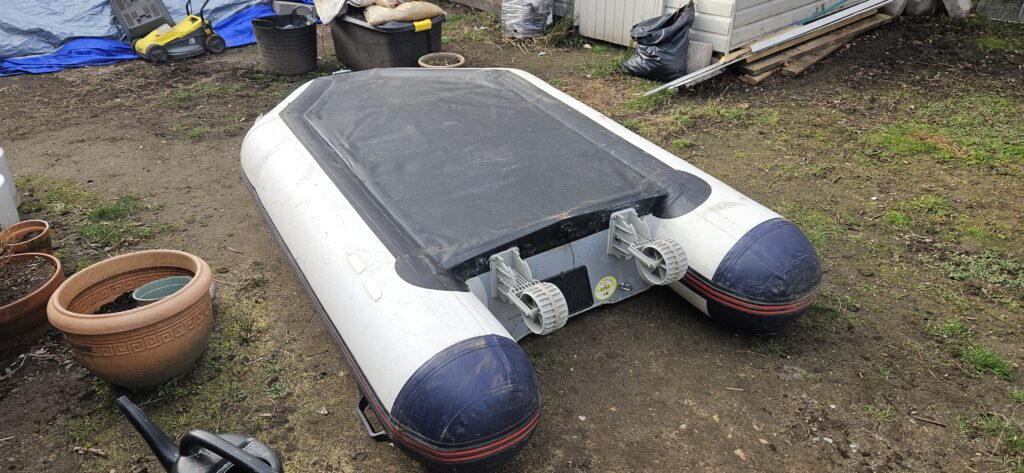 After I got home I got the tender out of the shed and inflated it. I have created three patches using the roofing rubber off-cuts, one to protect the keel area around the transom and two matching patches to cover where the tubes got scratched and poorly patched. These last two should ensure I don’t need to pump up the tender every week
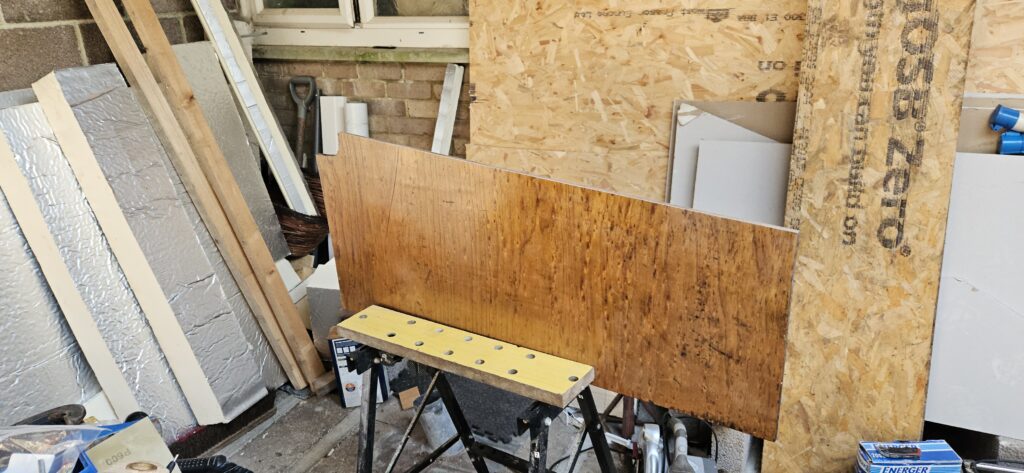 I have also removed the extra plywood which prevents the water bladder locker top from going into the recess properly. This edge will need to be varnished before it goes back on the boat.
This evening was the LSC launch supper so we were out until about 10:30.
Sunday 23rd After lunch I headed for the boat to with the intention of doing some painting on the cabin roof where the original paint has worn a bit thin. However there is a bank of ominous looking cloud around so I have postponed the painting session and instead did some more cleaning, tidying and sorting. The end result of that was a somewhat usable cabin with some of the upholstery pieces in their right places. There were also one heavy bag of tools going home and a bucket with two paint cans.
Monday 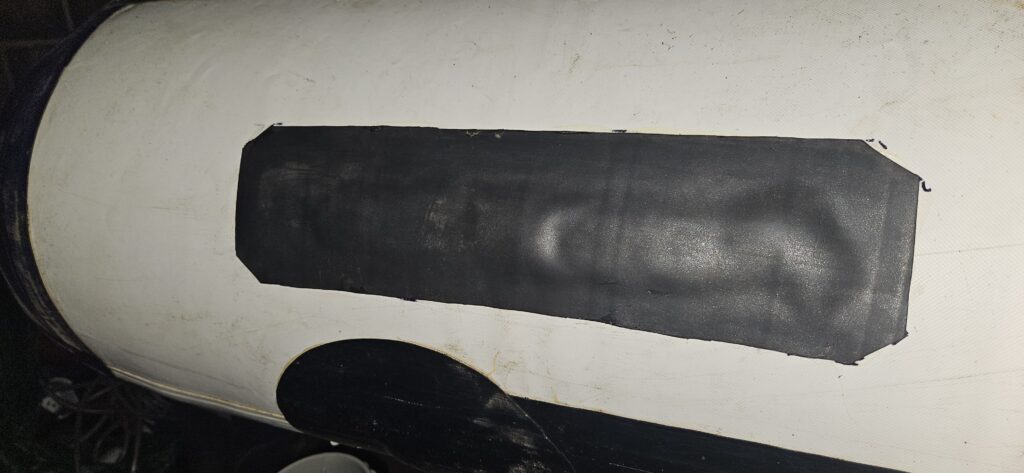 Today I was awake at 6 so I got dressed and went out into the extension to glue the three rubber patches onto the tender. The two on the air tubes are at least 2cm larger than the combined patches from the repair kit. This should be an effective block for any leakage around the existing patches as well as for undetected leaks in the other scuffs.
Most of the early afternoon was spent tidying up the cabin while sorting out the tools and spare parts that are staying on the boat.
After that I started looking through the cooking equipment to rationalise it. I seem to have gained at least some kitchen cast offs from each of the children as well as our caravan stuff so I need to decide which items are junk and try to keep only things that I will really use.
Tuesday 25th March I spent the afternoon at the sailing club – Partly delivering a piece of stainless steel for Karl but mainly removing unnecessary tools from the boat and doing a partial exchange in the cooking equipment on the boat. There was also a start to the removal of rubbish from the boat.
When I got home I loaded the inflatable dinghy into the car so I am ready to go back tomorrow morning and fit the mooring strops on my riser chains ready for Thursday. Ideally that till get done fairly early so I can finish getting the boat ready.
Wednesday
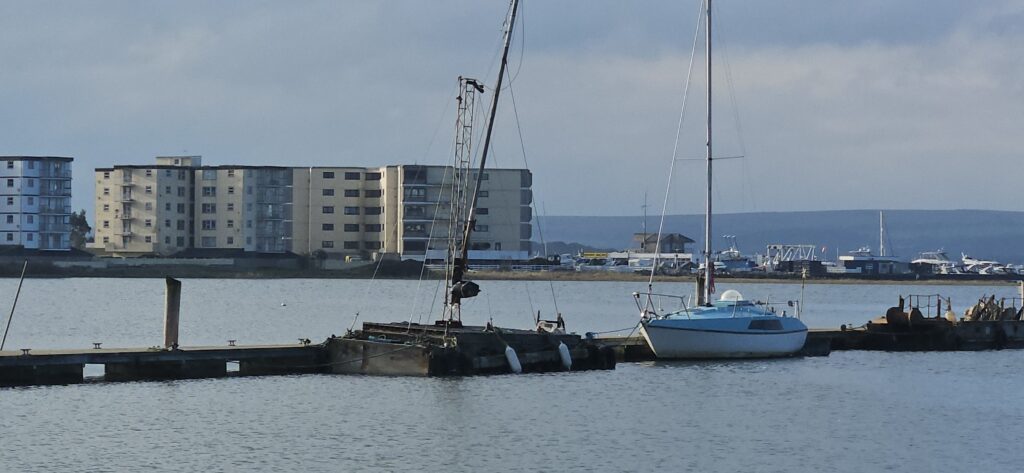
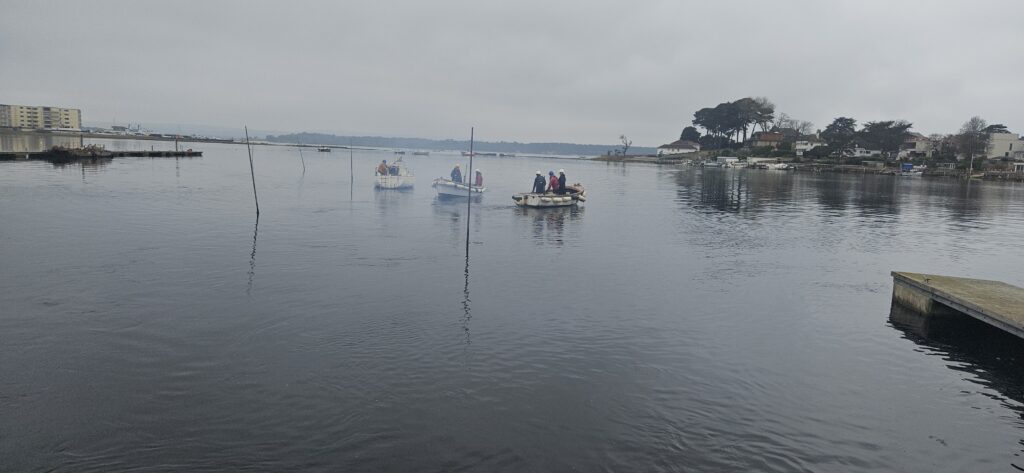
 I was at the sailing club before 7 and rowed the tender out to put the strops onto my mooring. Before I disturbed it the lagoon was mirror smooth (small mud patches & mooring buoy included proving it is a real photo and remind me which way up it should go).
The rest of the morning was devoted to sorting out the content of the cabin and helping others with last minute tasks.
Fog had come in fairly thick during the morning to the extent that around lunch time you couldn’t see the end of the pontoon from the club house.
I was home around 3pm and took the dog for a walk.
Every time I went near a petrol station in the afternoon there was a queue but I finally managed to get 11 L of petrol from one at around 9:30. That means I am set up to fill the tank tomorrow. Today was the spring financial statement from the government so maybe everyone was anticipating an increase in fuel duty?
Thursday 27th First lift in day I was at LSC before 6 and therefore had the opportunity to check the outboard before the crane arrived. As far as I can everything is ready to go back in the water.
As seems to be usual I was involved in getting the crane set up and then helps with at least half of the boats that went in before me – High tide was not particularly high and was early in our time session so the deeper draft boats had to go in first. We finally got to Rathenice on a falling tide and after a few boats had needed towing out to their moorings by the launches. My trip to the mooring was similar –
- There was no time to get the rudder on while still alongside and I had hoped to do that on the way out to the mooring. I just about got it done by the time we arrived.
- I had rather little steering accuracy on the outboard which didn’t help with following the channel.
- I came to a halt just where another shallower draft boat got stuck half an hour later so needed a tow out to the mooring to ensure I didn’t block the channel.
 I was back on shore shortly afterwards and working on a move of crane location followed by several more boats going into the rapidly vanishing channel or alongside the pontoon. Most of these will have to await tonight’s high tide or get moved first thing tomorrow to make room for more boats. One “trapped” boat is inside the lagoon fairly close to the short pontoon; the other is just outside the opening in the wall and has been left with enough crew on board to be able to get onto their mooring as soon as they float off at around 6pm.
Overall it has been a good day with only 4 of the boats still ashore that were on today’s list but at least that many small draft boats already done off tomorrow’s list ready for their owners to move them.
Friday 28th. 2nd lift I was aiming to be at the club before 6 to help a member who’s boat is currently on the short pier but needs to be on the mooring and preferably with the mast up so that he can get to a 9am funeral. The rest of the team are not necessarily needed until 6:30 or even 7 although there will be boats going in as soon as we can because high tide is only at about 8:20 and we need to get most of the larger draft boats in as early as possible.
Unfortunately they were suffering problems with their outboard so after a bit of tinkering they got a tow out to the mooring and then back with the engine to work on it ashore. That freed me up to help get boats into the water. The first boat was in the lagoon slightly before 6:00 so we were off to an earlier start than planned.
I ended up helping Andy C get his boat out onto the mooring. That turned out a little more complicated than expected because his first approach was on the wrong mooring – Easily done when there are no other boats in a particular patch and you cannot see the number until you are on top of it. That actually helped later on because the pickup rope and chain were tangled up meaning the real owner would have had a lot of difficulty when they came to moor. We managed to tidy up some of the tangles and once we got back in we were able to warn him that he would need to take his tender out to access the chain more easily.
We then moved on to the right mooring which picked up easily.
By about 10:30 we had all the planned boats out on the water as well as the four or five brought in for maintenance. We then retrieved the mooring maintenance barge for that to be worked on.
First published 3rd February. Updated 4th, 8th, 9th, 13th, 14th, 16th, 17th, 19th, 24th, 29th.