Good Friday (Bank holiday) Early start again today (only slightly before the alarm but still earlier than needed). Started by fitting conduit for the navigation light cables. Initially fixed with the sticky foam that  comes with them but I know that wont stay attached to the fiberglass for long so I used the remaining resin to fix them in place with strips of random mat.
Second job was somewhat noisier – Cleared out the heads including removing the toilet so I can service it properly. During the process I 
 measured the sail cover so I can make a replacement. The photos plus a complex set of measurements should help make the new cover.
Then sanded both plywood bulkheads, the back of the door, the hull and the floor molding. First coat of varnish on most of those surfaces 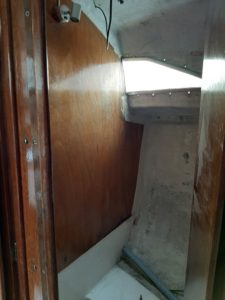 but second on the rear bulkhead. Hopefully it will come out better than the first as there is still a lot of rough wood near the window – Maybe too much sunlight over the years..
Then started a long set of serial varnishing tasks. Door, both heads bulkheads.
Having done those I then sanded and varnished the two rubbing strakes. Looks really good with the contrasting plugs – Maybe I need to replace all of the remaining originals for a consistent appearance.
Saturday Woke at 5:30 and had done all the washing up etc to be out on the boat by 7:30. Wired up the third main bilge pump so we should now be able to cope with a fairly major water ingress – still haven’t  wired up the deeper level float switch that is intended to trigger all three pumps regardless of any jamming or failure of pump specific float switches.
Next job was to create the oak wedge that will hold the compass light at the required angle. Took quite a long time to get the shape right because I had to be cautious while working with a block that was not 
 much bigger than the light. Shaping and mounting holes all finished and the first coat of varnish done in time for lunch.
I also did a little work on the original compass, finding that the reason for the rattle is that two brass screws were loose inside the case. These are the non-magnetic solution to holding the lead balance weight in place which makes the compass swing on it’s gimbles. The plastic columns (possibly genuine Bakelite being from the 1970s) had broken off with the screws still in place so a little superglue fixed th e problem.
Finished the gloss white paint by doing the inside of the hull in the heads compartment. Seem to be several other shops that stock the paint so B&Q may have lost that particular purchase through their queue process.
As well as a long walk with the dog there were a few smallish jobs tackled this afternoon including filling and  fairing a few bits of damage to the fiberglass surfa
ce. The chip in the bow was caused by the trailer flexing on the way to the drive after a pothole so I will eventually have to be careful on the way back. The other deep gouge remains a mystery but the algal growth suggests it was old damage.
Started grinding out the fiberglass around a crack on the starboard bilge keel. Not sure how deep it goes or what the origin was but this  one was present when I collected the boat. The aim is to grind it down quite deep and then re-do the layup to get back the original strength and shape. Not sure whether this is just gel coat cracking off the original encapsulated keel or a sign that water had been getting into contact with the metal and expanding so careful grinding is needed. Not a simple job because the trailer mudguards and possibly framing are in the way. Might end up being a superficial fix now and another look see over next winter with the boat laid up on wooden blocks instead of the trailer. Will definitely need to get a couple more of the bigger resin tins to do the repair which will need to end up at least 3 times wider than the current grinding area.
Final boat job for the day was ordering the headline and wall covering fabric, Velcro tape, foam padding and canvas for the sail cover and cockpit cover.
Easter Sunday (12th ) Early start again. Outside and working on the boat for 8:00. First job was to install the compass light now that the two coats of varnish have dried. Much neater than the original and hopefully less impact on night vision in the event that I end up needing to use it. You might wonder why I need a light given that there will  usually be phosphors painted on such instruments to give night vision. Well yes it does have all of
  those but, being presumably at least 45 years old, the only part of the pattern that shows visible emission at night is the open arrow that you rotate to show the intended course. Presumably the radiation in the glass capsules and paint of the other markings has decayed too much to be noticeable when I tested it on a residential street at 11pm a couple of nights ago. Might do better in a true dark night away from even LED street lights, we will see.
Although I don’t have any of the original gloss white paint left I do have some outdoor wood & metal paint so have used that to paint the  inside of the galley storage lockers. Once that has dried I will re-install the front using the stainless steel pan head bolts instead of the random selection of plain steel ones I used for the temporary fitting.
As Grace is getting set up ready to move to East Anglia as a qualified doctor rather than a medical student, the boat is benefiting from some of the kitchen equipment saved for her but which she prefers to replace. Even though the virus means we don’t get to attend a graduation any time soon, achieving clean cupboards to put frying pans into seems like a major indication how the shutdown has aided progress with my restoration work and how much closer to launching I am.
Another one of those 3D puzzles this afternoon as I was making a spacer to support one of the two gel-cells that will form the leisure battery part of the electrical system. I am using the two 12V batteries  that we removed from Helen’s bigger disability scooter a couple of years ago when she became convinced the batteries were failing – New ones didn’t fix the lack of range so I think these are two perfectly good batteries and have regularly trickle charged them in the meantime. Today is the first time there have been two sets of batteries rather than both connections being joined to the starter battery. So tomorrow I will have to do the same piece of geometric juggling for the other battery in the leisure bank. The selector switches both work so as an emergency
 precaution I can run the bilge pumps (plus the associated Arduino & drier pumps), marine radio and navigation lights off either set of batteries although usually they will be set to the leisure battery bank.
Monday (Easter Monday) Woken by the alarm as per a normal working day. After the usual washing up and kitchen tidying I ventured out into the windy chilly conditions outside. As forecast it is quite a contrast to yesterday but might help fighting the virus by keeping people inside.
Started off with another coat of paint on the plywood shelf between  the two lockers under the cooker space. It is fiberglassed in but I probably need to replace or reinforce that as it is de-laminating where rainwater and condensation have sat on the unprotected wood. Now protected with 2 coats of paint on the top surface and it is not structural so any repairs can wait a while.
Next job was to re-fit the front of the galley using the stainless steel bolts. Looking good even if it does still need magnetic catches to keep the doors closed when not under way.
Not yet got any details of the likely dispatch of the headlining fabrics but I spent the afternoon looking at the original plywood reinforcing and scraping off the remaining foam. Most of the boards will be re-usable rather than having to wait until I can order large enough sheets of new 3mm ply.

Definitely have to replace the  boards involved in the ceiling because of rot and several attempts to stick the boards to the cabin roof with resin based filler. Unfortunately those two pieces account for 2 of the 4 sheets which I would need to do the whole job from new. They are each well over half the width and almost the full length of an 8’ by 6’ sheet; no way to make them both out of one sheet to economise on plywood. Obviously I also need to work out and install a better system of blocks to hold the lining on the ceiling as well as making sure there are no remaining leaks in the roof.
Although the plywood gives the rigidity to the lining it never seems to have been all that close to the edges so I have started by going round the starboard side of the main cabin measuring and marking off the amounts that the lining needs to overlap the board edges by. After the first board I changed plan so the whole construction process will be covered in it’s own post.